This article was originally published in Tech Times.
AI-enabled systems are already changing how wars are fought in Ukraine, Gaza, and Iran. In the United States, recent efforts to move AI more quickly into military operations have deepened concerns that autonomous or AI-assisted targeting without strong oversight could result in civilian deaths. In June, President Donald Trump issued a memo calling on the U.S. military and national security agencies to accelerate their use of AI, even as the memo acknowledged the need for oversight of autonomous weapon systems. Even so, many national security officials are still pushing to get these technologies onto the battlefield faster.
In the rush to deploy new tools, basic questions remain unresolved. Are there gaps or design flaws that increase risks to civilians? How much meaningful human control remains over critical military decisions? Those questions deserve clearer answers before speed becomes the measure of success.
What WPS Adds
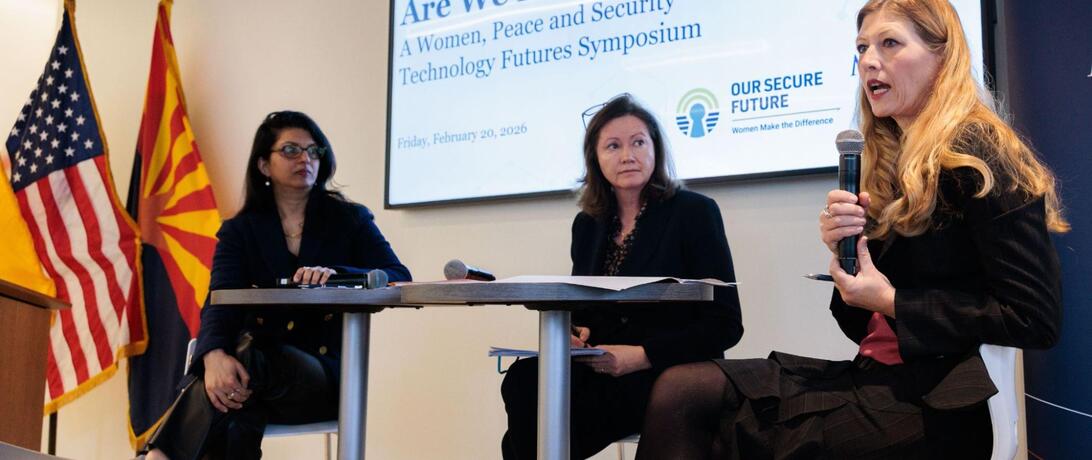
The Women, Peace and Security agenda offers a practical way to understand conflict, improve security decision-making, and support more durable peace. The white paper by Sahana Dharmapuri and Jolynn Shoemaker, Women, Peace and Security and Technology Futures: What World Are We Building?, considers how this agenda applies to current decisions about technology and security.
UN Security Council Resolution 1325 on Women, Peace and Security identified three core realities: conflict affects women and children in distinct and disproportionate ways; women play essential roles in peacebuilding; and peace and security decisions are more effective when women are fully included. The resolution established a global mandate to bring these perspectives into peace and security policymaking. In the United States, those principles were later codified in the Women, Peace and Security Act, signed into law in 2017.
More than twenty years after Resolution 1325, the record is clearer about what makes peace durable and what makes people less secure. Security structures that exclude affected communities, especially women and girls, are neither effective nor sustainable. Yet that same pattern of exclusion now shapes technology and security policymaking today, obscuring early warning signs and creating new blind spots.
At its core, Women, Peace and Security calls on policymakers to safeguard civilians, uphold humanitarian and human rights law, and ensure that women and civil society can meaningfully shape security decisions. That framework is especially relevant now, as AI and other emerging technologies are moving more quickly into conflict and military policy.
Who Pays the Price
Dharmapuri and Shoemaker use this framework to show how AI and other emerging technologies can create several layers of risk for civilians. Systems trained on incomplete or outdated data may miss crucial realities on the ground, worsening the fog of war and making it harder to distinguish civilians from combatants. Inaccurate recommendations or hallucinations can push decision-makers toward the wrong conclusions. Biases embedded in the data or design of these systems can also increase errors.
These concerns are not abstract. Human Rights Watch and other civilian protection monitors have raised concerns about the use of AI and digital targeting tools in Gaza, including allegations that AI-generated targets were sometimes reviewed in only seconds before strikes.Those dangers grow when institutions rely on AI to speed up decisions, weakening meaningful human judgment and accountability.
Women, Peace and Security also recognizes that civil society and women-led organizations are often the first to identify security threats from the perspective of civilians. While many national security actors are focused on the next military application of new technology, groups working in the Women, Peace and Security space are focused on how those same tools affect communities. For example, UN Women has run cyber resilience training in countries including Bangladesh and Timor-Leste to help women peacebuilders, journalists, and human rights activists monitor and respond to digital threats. Peacebuilders around the world understand that civilians, often including women and children, are the ones most likely to pay the price when blind spots go unaddressed and accountability is weak.
What Policy Must Change
Women's perspectives and participation are not side issues in peace and security. They are part of what makes security policy more effective and more accountable. Yet those voices have often been sidelined in debates over how emerging technologies are used in conflict, despite the clear consequences for civilian protection and compliance with humanitarian and human rights law. The record of Women, Peace and Security shows that decisions shaped only by those who wield force rarely lead to lasting peace.
That is why Women, Peace and Security must be part of today's debates over emerging technologies and conflict. These commitments still apply in an age of AI and new forms of war. They require tougher questions about how these tools are designed, tested, governed, and deployed, and a more transparent public debate about where they belong and what safeguards must come first. If civilian protection is treated as an afterthought, these technologies will not make war safer. They will make its consequences easier to excuse.